What NZ’s 2025 investment boost means for your business

Source: CAANZ Auckland & Northland Regional News Ed16 25.8.2025: Article by: John Cuthbertson CA is CA ANZ New Zealand’s Tax Leader. He is responsible for engaging with New Zealand’s Inland Revenue Department and Treasury on tax law reform, policy settings and administration.

KiwiSaver changes

If you are an employer, you need to be aware of several changes to KiwiSaver which will come into effect on 1 July 2025, 1 April 2026 and 1 April 2028.

Government KiwiSaver contributions – 1 July 2025 Changes

The government contribution has dropped from 50 cents to 25 cents for each dollar you contribute to KiwiSaver each year, dropping the maximum government contribution from $521.43 to $260.72.

People aged 16 and 17 will now qualify for government contributions, so long as they meet other eligibility requirements. Prior to 1 July 2025, members must be 18 or older to qualify.  

People who earn more than $180,000 of taxable income in a year will no longer qualify for government contributions. 

There’ll be no change to government contributions for the year ending 30 June 2025. These will be paid in July and August at the current government contribution rate.

Default employer and employee contribution rates – 1 April 2026 Changes

The default KiwiSaver contribution rates for employers and employees will rise to 3.5% (from 3%).  

Members will be able to apply for a temporary rate reduction from 1 February 2026 if they wish to continue contributing at 3% from 1 April 2026. 

As an employer, you will be able to match your employee’s temporary rate reduction. Once your employee moves to a higher contribution rate, you will need to increase your employer contributions to the default 3.5% rate. Inland Revenue will notify you of this.

People aged 16 and 17 will qualify for employer contributions from 1 April 2026, so long as they meet other eligibility requirements. If they contribute to KiwiSaver from their wages, you will need to start making employer contributions.  

1 April 2028 changes

The default contribution rates for employers and employees will rise to 4% (from 3.5%).  

Source: KiwiSaver changes(external link)

Disclaimer
Unfortunately, with details changing all the time and at such speed, we need to add that the above content is correct at the time of writing as far as the author is aware and is very much subject to change. We have, to the best of our ability, acknowledged any shared content. All related links provided to the corresponding websites are subject to change as they are live links.

Good Governance and the Charities Act

The Charities Act changed in 2023 and now there is a new requirement related to the governance of your charity. Charities will now need to review their governance every three years. When you come to file your annual return, there will be a new question in the form asking whether you have reviewed your governance and the date you did the review.

Please note that this is a self-directed review and will be different for every charity. Charities vary immensely in size, skill and capacity.

The most important thing to remember when reviewing your current governance activities and procedures, is to think about whether what you have in your governance kete is “fit for purpose”, if it “assists your charity to achieve its charitable purpose” and “assists your charity to meet your legal requirements”.

We recommend starting with your rules document, your essential policies and procedures.  You can find your rules document on the Charities Register.  Take a good look at your most essential governance tools and see if they are still working for you.  Think about the biggest areas of risk for your charity and plan to mitigate them with good governance.

Source: https://not-for-profit.org.nz/good-governance-and-the-charities-act/

Disclaimer
Unfortunately, with details changing all the time and at such speed, we need to add that the above content is correct at the time of writing as far as the author is aware and is very much subject to change. We have, to the best of our ability, acknowledged any shared content. All related links provided to the corresponding websites are subject to change as they are live links.

Charities Services Update – Tier 4 Annual Reporting Guide

The Tier 4 Annual Reporting Guide has been updated. This guide provides information about the annual return process, and step-by-step instructions with examples to help charities complete their performance reports using the Tier 4 template. It will help Tier 4 charities meet their obligations under the Charities Act 2005, and the current financial reporting standards set by the External Reporting Board (XRB).

The Charities Services have updated the performance report templates for Tier 3 and Tier 4 reporting, to help make it easier and faster to complete your annual returns. 

Using these templates ensures that you are using the correct reporting standards and that you have included all the required information. 

You can download the Tier 3 and Tier 4 templates from their website: https://www.charities.govt.nz

Sourcehttps://www.charities.govt.nz/ (Newsletters)

Disclaimer
Unfortunately, with details changing all the time and at such speed, we need to add that the above content is correct at the time of writing as far as the author is aware and is very much subject to change. We have, to the best of our ability, acknowledged any shared content. All related links provided to the corresponding websites are subject to change as they are live links.
Interest on overpayments and underpayments (UOMI)

From 8 May 2025 the UOMI rates on underpayment and overpayment of tax will change.  If you overpay any tax or duty, the IRD will pay you back with interest.  If you underpay tax, the IRD will charge you interest.  They may also charge a penalty with interest.  This is often called use of money interest, or UOMI.

What interest is applied to:

  • child support deductions by employers (CSE)
  • FamilyBoost (FMB)
  • fringe benefit tax (FBT)
  • goods and services tax (GST)
  • imputation accounts
  • income tax
  • KiwiSaver contributions
  • non-resident withholding tax (on interest and dividends)
  • PAYE deductions
  • residential land withholding tax (RLWT)
  • resident withholding tax (RWT) (on interest and dividends)
  • student loan deductions by employers
  • ESCT (employer superannuation contribution tax)
  • Working for Families Tax Credits (WfFTC)

Interest Amounts

Interest gets calculated daily on your overpaid or underpaid tax. It does not compound and is not included when calculating penalties.  The interest rates are set by Government and are based on market rates, so they vary over time.

The new rates are:

  • Underpayment – 9.89% down from 10.88%
  • Overpayment – 3.27% down from 4.30%

When interest starts

If you’ve underpaid tax or duty, interest:

  • starts on the day after the original due date for the amount owing, or
  • starts from a new due date (if you received Working for Families Tax Credit and you meet specific criteria to have a new due date)
  • stops on the day the overdue balance (including interest) gets paid in full.

If you’ve overpaid tax or duty, interest starts on the latest of either:

  • the day after the original due date
  • the day after payment.

Source:  IRD: https://www.ird.govt.nz/managing-my-tax/penalties-and-interest/interest-on-overpayments-and-underpayments

Disclaimer
Unfortunately, with details changing all the time and at such speed, we need to add that the above content is correct at the time of writing as far as the author is aware and is very much subject to change. We have, to the best of our ability, acknowledged any shared content. All related links provided to the corresponding websites are subject to change as they are live links.
 

Small Business Cashflow Loan Scheme

For most borrowers, the five-year loan term of their Small Business Cashflow Loan (SBC) contract ends in 2025. Avoid unnecessary default interest and think about repaying your loan now.

There are a few things you can do to check you’re on top of your loan.

  • Log in to myIR to check how much you owe and when your final repayment date is.
  • Make extra payments in myIR to avoid default interest charges of 13.88%. Make sure you select your SBC loan as the debt you want to pay.
  • Set up a repayment plan if you cannot repay the outstanding balance in full. To set-up a plan, you need to send us a message in myIR or call us.

Having a repayment plan in place means your interest rate will be 3%.

If you haven’t kept up to date with your repayment plan, now’s the time to get back on track.

You can avoid unnecessary default interest by setting up regular monthly payments to lower your balance as quickly as possible.

If you have more than 1 repayment plan, use your unique repayment plan identifier when making repayments. Your repayment plan identifier is called the ‘Media Number’ and you can find it at the top of letters you get from us.

If your SBC loan is unpaid 20 working days after the final repayment date, the loan will default and we may:

  • demand full payment
  • add default interest of 13.88% to the outstanding loan balance
  • take legal action.

More info: If you default on the Small Business Cashflow Scheme loan

More info: Interest and Repayment

Source:  IRD:  https://www.ird.govt.nz/sbc-loan

Disclaimer
Unfortunately, with details changing all the time and at such speed, we need to add that the above content is correct at the time of writing as far as the author is aware and is very much subject to change. We have, to the best of our ability, acknowledged any shared content. All related links provided to the corresponding websites are subject to change as they are live links.

New Legislation for Incorporated Societies

Between 5 October 2023 and 5 April 2026 there are two Acts in force – which one applies to your society depends on which Act it’s registered under. 

The Incorporated Societies Act 2022 Act (“2022 Act”) applies if your society:

  • registered for the first time on or after 5 October 2023, or
  • registered before 5 October 2023 and has reregistered since then.

The Incorporated Societies Act 1908 (“1908 Act”) applies if your society:

  • registered before 5 October 2023, and
  • has not yet reregistered.

If you’re not sure which Act applies you can check by searching the Incorporated Societies Register for free. How to search the register 

Existing Societies Must Reregister

If your society wants to continue operating as an incorporated society it must reregister under the 2022 Act before April 2026. You should understand what it means to reregister and what happens if your society doesn’t reregister.

There are a few things your society will need to do before it reregisters, such as preparing some documents and possibly adopting some new processes to comply with the 2022 Act.

For example, under the 2022 Act, your society will need to —

Until your society reregisters it must operate under and comply with the 1908 Act.

What happens to your society if it doesn’t reregister?

If your society doesn’t reregister before 5 April 2026, it will cease to exist. This means it would no longer be an incorporated society which has the following implications:

  • This removes your right to make decisions on behalf of your society, such as, deciding what happens to any assets it owns. The Registrar could direct how to distribute them instead.
  • This takes away the separate legal identity your society previously had. This means members could be held personally liable for debts or obligations (such as leases) owed by the society. Similarly, your society could not sign any new contracts in its name.
  • The name your society used will no longer have any protection – another group could incorporate using the same name.

Society-based charitable trust boards can reregister as an incorporated society

Society-based charitable trust boards – those incorporated under the Charitable Trusts Act 1957 — can now choose to reregister under the 2022 Act or remain registered under the Charitable Trusts Act 1957.

If your organisation chooses to reregister it would change entity type:

  • from a charitable trust board
  • to an incorporated society.

You may need to seek expert advice from your lawyer, accountant or other professional to help you decide which organisational structure best suits your needs.

  • If you decide to reregister, you can apply any time
  • If you decide not to reregister, your trust board will remain on the Charitable Trusts Register. You will be able to continue operating as you do now.

Learn more about charitable trust boards reregistering as incorporated societies: Source:  IRD: IncorpSocieties

Disclaimer
Unfortunately, with details changing all the time and at such speed, we need to add that the above content is correct at the time of writing as far as the author is aware and is very much subject to change. We have, to the best of our ability, acknowledged any shared content. All related links provided to the corresponding websites are subject to change as they are live links.

New ESCT and FBT Changes

Employer superannuation contribution tax (ESCT) and fringe benefit tax (FBT) thresholds have changed. FBT calculation methods have also changed.  From 1 April 2025, employer superannuation contribution tax (ESCT) and fringe benefit tax (FBT) thresholds will change.  FBT calculation methods will also change.

What you need to do

If you haven’t yet, check that you have the most up-to-date version of your payroll software (if you use software).  Your payroll software should have updates for these changes.

If you calculate ESCT yourself, the PAYE deduction tables (IR340 and IR341) have been updated and are available now.

ESCT threshold changes

An example of ESCT is an employer’s contribution to an employee’s KiwiSaver scheme.  ESCT is the tax that is deducted from this contribution.

The new ESCT thresholds take effect from 1 April 2025.

New ESCT ThresholdsTax Rate
$0 – $18,72010.5%
$18,721- $64,20017.5%
$64,201 – $93,72030%
$93,721- $216,00033%
$216,001 upwards39%

Employer superannuation contribution tax

FBT changes

You need to apply a new alternate tax rate calculation method for the first time.  The new rate applies from 1 January 2025 and is for final quarter returns.

The new FBT thresholds take effect from 1 April 2025.

New FBT ThresholdsTax Rate
$0 – $13,96211.73%
$13,962 – $45,23021.21%
$45,231 – $62,45042.86%
$62,451 – $130,72349.25%
$130,724 upwards63.93%

Fringe Benefit Tax Rates:  Fringe benefit tax rates

Source:  IRD  https://www.ird.govt.nz/income-tax-changes

Disclaimer
Unfortunately, with details changing all the time and at such speed, we need to add that the above content is correct at the time of writing as far as the author is aware and is very much subject to change. We have, to the best of our ability, acknowledged any shared content. All related links provided to the corresponding websites are subject to change as they are live links.

Minimum wages increase from 1 April 2025

From 1 April 2025:

  • the adult minimum wage will go up from $23.15 to $23.50 per hour
  • the starting-out and training minimum wage will go up from $18.52 to $18.80 per hour
  • all rates are before tax and any lawful deductions, for example, PAYE tax, student loan repayment, child support.

What to do now

Take this opportunity to review your business processes, employment records and systems.

  • Check that your payroll system is ready and updated for the 1 April changes, whether you have a manual or computer-based system.
  • Re-calculate and update your budgets and cashflow as the increase may have an impact, including on items such as ACC levies, KiwiSaver contributions and holiday pay.
  • Review the pay rates for skilled employees from 1 April.
  • Consider reviewing your pricing strategy.

Tools to help you

The free cash flow forecast tool can help you plan for the minimum wage change.

Cash Flow Forecaster(external link)  The free employment agreement builder can help you make sure future agreements have the correct minimum wage details.

Employment Agreement Builder(external link) Employment New Zealand also has tips on how to prepare for 1 April on its website.

Minimum wage is increasing on 1 April 2025. Are you ready?(external link) — Employment New Zealand

Source:  Business.govt.nz info@ub.comms.business.govt.nz

Disclaimer
Unfortunately, with details changing all the time and at such speed, we need to add that the above content is correct at the time of writing as far as the author is aware and is very much subject to change. We have, to the best of our ability, acknowledged any shared content. All related links provided to the corresponding websites are subject to change as they are live links.

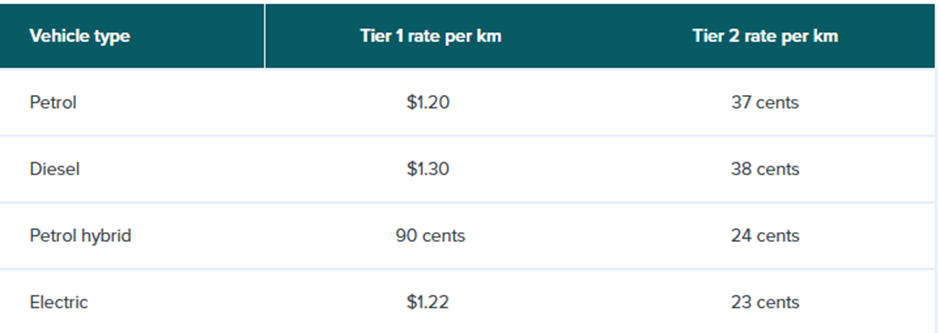
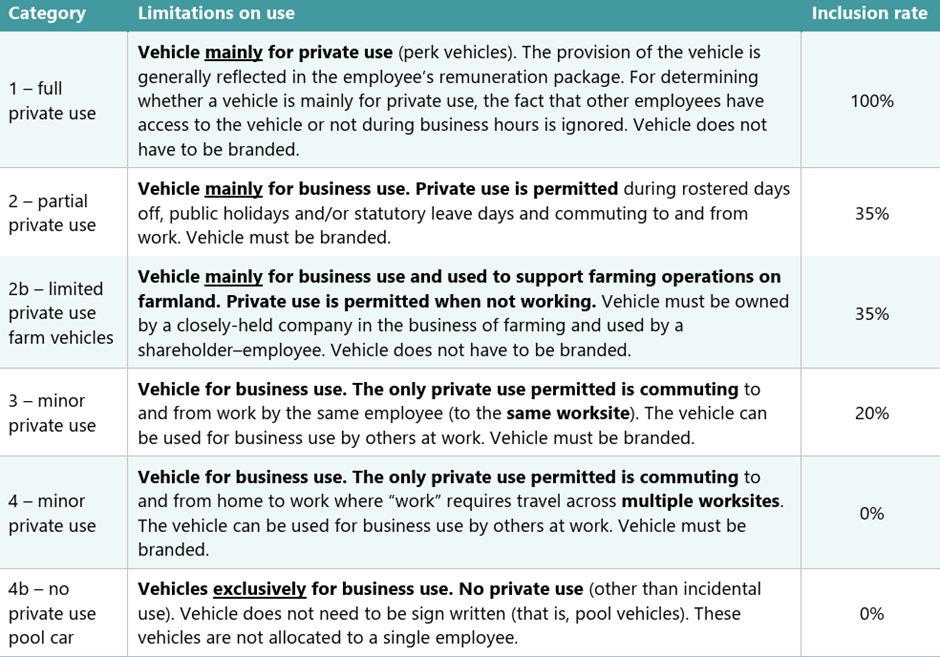
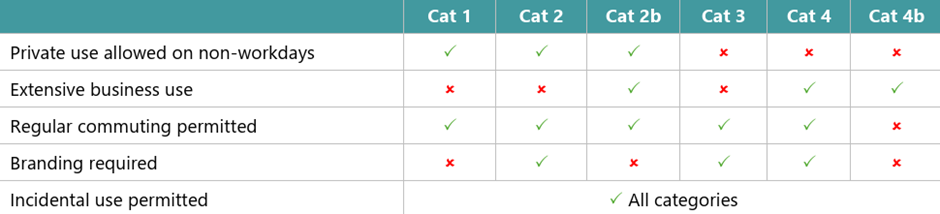
Employer Provided Motor Vehicles for Private Use

  • Employees must be provided with a letter of restriction stating that the work related vehicle is not available for private use except for travel between home and work, and for travel related to the business.
  • Checks need to be done quarterly (every 3 months) to make sure employees are only using the vehicles for work-related purposes.
  • they stay away from home overnight with the vehicle
  • they are away for more than 24 hours
  • they need the vehicle to perform their work.

Tax-e-mail Issue 2404

IR409-2022 https://www.ird.govt.nz/-/media/project/ir/home/documents/forms-and-guides/ir400—ir499/ir409/ir409-2023.pdf?modified=20240514224901&modified=20240514224901

IRD https://www.ird.govt.nz/employing-staff/paying-staff/fringe-benefit-tax/types-of-fringe-benefits/employer-provided-motor-vehicles-for-private-use